

V-belts are one of the most commonly used power transmission components in machinery. Whether you’re working with an HVAC system, agricultural equipment, or industrial conveyor, selecting the right V-belt size is crucial to ensure efficiency, minimize wear and tear, and avoid downtime.
In this comprehensive guide, we’ll walk you through everything you need to know about V-belt size charts, including V-belt types, measurement methods, standard classifications, and how to decode belt numbers. This article is tailored to help engineers, mechanics, and maintenance professionals accurately determine V-belt dimensions for replacement or installation.
What is a V-Belt?
A V-belt is a type of drive belt with a trapezoidal cross-section. This shape allows the belt to sit tightly in the grooves of a pulley, delivering superior grip and power transmission with minimal slippage.
V-belts are widely used because of their efficiency, low cost, and ease of installation. However, choosing the wrong size can lead to performance issues or mechanical failure.
Key V-Belt Dimensions You Must Know
When referencing a V-belt size chart, the following parameters are essential:
- Top Width (W) – The width across the top of the belt.
- Thickness (T) – Also referred to as height or depth.
- Pitch Length (PL) – Distance measured at the pitch line (near the belt’s neutral axis).
- Outside Length (OL) – The outermost length of the belt.
- Inside Length (IL) – The innermost loop length of the belt.
Types of V-Belt Size Chart and Their Size Standards
There are different types of V-belts, each conforming to specific sizing standards. Here’s a breakdown of the most common categories:
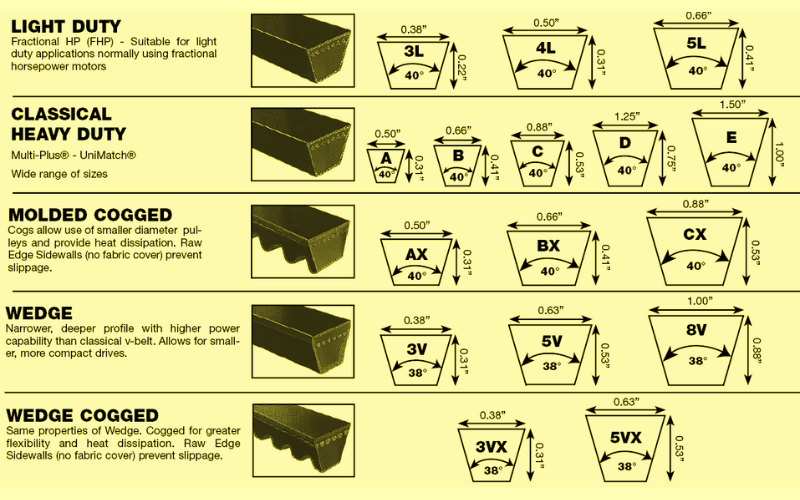
1. Classical V-Belts (A, B, C, D, E)
These are standardized according to ANSI RMA IP-22 and are widely used in general industrial applications.
| Section | Top Width (inches) | Thickness (inches) | Typical Pitch Length (PL) |
|---|---|---|---|
| A | 0.50 | 0.31 | PL = OL – 2.0” |
| B | 0.63 | 0.41 | PL = OL – 2.4” |
| C | 0.88 | 0.53 | PL = OL – 3.6” |
| D | 1.25 | 0.75 | PL = OL – 5.3” |
| E | 1.63 | 1.06 | PL = OL – 7.0” |
Note: OL (Outside Length) is typically used to mark belt length on A, B, C belts.
2. Narrow V-Belts (3V, 5V, 8V)
Narrow-section V-belts are more efficient at higher speeds and loads. These conform to ARPM standard IP-26.
| Section | Top Width (inches) | Thickness (inches) | Designation Length |
|---|---|---|---|
| 3V | 0.38 | 0.31 | PL (Pitch Length) |
| 5V | 0.63 | 0.53 | PL |
| 8V | 1.00 | 0.88 | PL |
Narrow belts have a higher power rating than classical belts for the same top width.
3. Fractional Horsepower (FHP) V-Belts (2L, 3L, 4L, 5L)
Used in low-power, light-duty applications such as home appliances and small tools.
| Section | Top Width (inches) | Thickness (inches) | Length Marked As |
|---|---|---|---|
| 2L | 0.25 | 0.16 | OL |
| 3L | 0.38 | 0.22 | OL |
| 4L | 0.50 | 0.31 | OL |
| 5L | 0.63 | 0.41 | OL |
These belts are usually labeled with their outside length, and the “L” stands for light duty.
4. Metric V-Belts (SPZ, SPA, SPB, SPC)
Metric belts are governed by DIN 2217 or ISO 4184, and are commonly used in European machinery.
| Section | Top Width (mm) | Thickness (mm) | Pitch Length Reference |
|---|---|---|---|
| SPZ | 10.0 | 8.0 | PL = Inside Length + ~22mm |
| SPA | 13.0 | 10.0 | PL = Inside Length + ~30mm |
| SPB | 17.0 | 14.0 | PL = Inside Length + ~40mm |
| SPC | 22.0 | 18.0 | PL = Inside Length + ~50mm |
How to Read a V-Belt Number
Understanding V-belt numbers can help you match or replace belts correctly.
Example 1: A45
- “A” indicates the belt section (Classical V-belt).
- “45” means the outside length is 45 inches.
Example 2: 5V750
- “5V” denotes a narrow V-belt section.
- “750” is the pitch length in tenths of an inch → 75.0 inches.
Example 3: SPB1900
- “SPB” = metric narrow section.
- “1900” = pitch length in millimeters.
How to Measure a V-Belt Accurately
If your belt markings have worn off, follow these steps to measure the belt:
Tools Required:
- Flexible cloth tape or string
- Vernier caliper or ruler
- Pulley for fitting reference (if possible)
Step-by-Step Guide:
- Mark the starting point on the belt.
- Wrap the tape around the outer surface to get the outside length.
- Measure the top width using a caliper.
- Check the thickness at the belt’s midpoint.
- Use standard conversion formulas to approximate pitch length:
- Classical: PL = OL – adjustment factor
- Metric: PL = IL + correction factor (e.g., 30mm)
V-Belt Cross-Reference and Interchangeability
While V-belts may look similar, mixing different standards can cause alignment issues or premature wear. Here’s a quick reference:
| Classical | Narrow | Metric Equivalent |
|---|---|---|
| A | 3V | SPZ |
| B | 5V | SPA |
| C | 8V | SPB |
| D, E | — | SPC |
It is not recommended to interchange belt types unless specifically approved by the manufacturer.
V-Belt Size Chart Summary Table
| Type | Section | Top Width (in / mm) | Thickness (in / mm) | Length Type |
|---|---|---|---|---|
| Classical V-Belt | A–E | 0.50–1.63 in | 0.31–1.06 in | Outside / Pitch |
| Narrow V-Belt | 3V–8V | 0.38–1.00 in | 0.31–0.88 in | Pitch Length |
| FHP (Light Duty) | 2L–5L | 0.25–0.63 in | 0.16–0.41 in | Outside Length |
| Metric (DIN/ISO) | SPZ–SPC | 10–22 mm | 8–18 mm | Pitch Length |
Tips for Selecting the Right V-Belt Size
- Always match the belt profile to the pulley groove.
- Measure old belts only if they’re not stretched or worn.
- Refer to manufacturer’s part numbers whenever possible.
- Use OEM-recommended belt types for critical applications.
- Consider using matched sets for multi-groove drives to avoid uneven wear.
Conclusion
Understanding the V-belt size chart is fundamental to ensuring reliable and efficient operation of machinery across all industries. Whether you’re performing regular maintenance or setting up a new drive system, using the correct V-belt dimensions and standards will ensure optimal performance and longevity.
We encourage engineers, technicians, and equipment managers to consult official size charts, maintain accurate records of belt types, and source from reputable suppliers to ensure long-term reliability.
For more detailed V-belt selection tools or product-specific charts, always refer to the manufacturer’s catalog or website for the most accurate data.
Need Help with V-Belt Selection?
Get in touch with Bijur Exim, your trusted distributor of industrial belts and power transmission components, for assistance with product selection, cross-referencing, and technical support.